

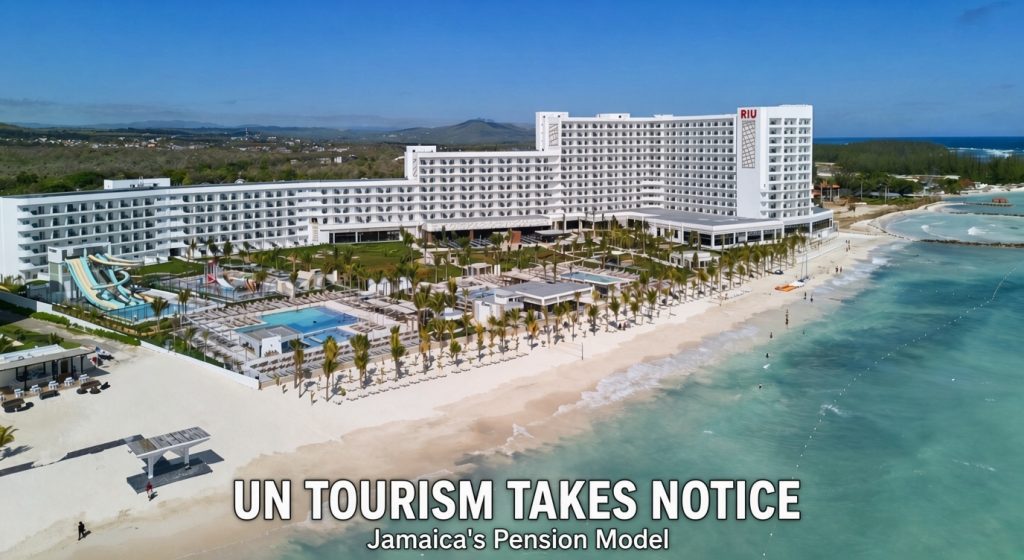
Jamaica’s Tourism Workers’ Pension Scheme is drawing international attention after UN Tourism officials identified the country’s approach to providing retirement security for tourism workers as a model that could have wider application.
Tourism Minister Edmund Bartlett made the disclosure on Tuesday, September 15, during a media breakfast held as part of the Jamaica Product Exchange (JAPEX) in Ocho Rios, St Ann.
Bartlett, who addressed the event virtually from Saudi Arabia, said he had met with UN Tourism officials earlier that day and that they highlighted Jamaica’s comprehensive approach to tourism-worker pensions.
According to the minister, the officials described the Jamaican model as “emulable” and indicated that it could be brought into the mainstream of tourism activity internationally.
Jamaica’s Pension Model
The Tourism Workers’ Pension Scheme was established to address the long-term financial security of people working across Jamaica’s tourism industry.
The programme became effective on January 31, 2020, and is designed to cover tourism workers between the ages of 18 and 59, including permanent, contract and self-employed workers.
Its coverage extends beyond traditional hotel employees to people working in areas such as craft vending, tour operations, red-cap portering, contract carriage and attractions.
Under the scheme, pension benefits are payable from age 65 or older, subject to the applicable requirements.
The Government of Jamaica initially committed J$1 billion to seed the pension fund. The Tourism Workers Pension Act, 2019 also provides for contributions from tourism operators and members, along with investment income and other resources to support the scheme.
Pension Scheme Passes J$6 Billion
The international attention comes as the pension programme reaches a new financial milestone.
Bartlett said the scheme has now accumulated more than J$6 billion in savings, with more than 10,800 tourism workers registered.
The latest figure represents further growth from the J$5.1 billion reported by the minister in March 2026, when the scheme had already surpassed J$5 billion in savings.
The Ministry of Tourism has previously said the programme was expected to benefit approximately 350,000 employees across the tourism sector, giving workers who may not have conventional permanent employment arrangements an avenue toward retirement benefits.
Why the International Interest Matters
Tourism employs people in a wide range of roles, including workers whose employment can be seasonal, contractual or self-employed. That can make long-term retirement planning more difficult than it is for workers in traditional employment arrangements.
Jamaica’s scheme was created with that reality in mind, bringing different categories of tourism workers under one pension framework.
The interest from UN Tourism could therefore give the Jamaican programme relevance beyond the local industry, particularly for other destinations where tourism represents a major source of employment and economic activity.
For Jamaica, the development also comes as the Government continues to focus on improving the professional development and overall welfare of tourism workers.
A Broader Focus on Tourism Workers
Bartlett has linked the pension programme to a wider effort to strengthen the position of workers within Jamaica’s tourism industry through training, certification and professionalisation.
The Tourism Ministry has also described the pension scheme as part of its broader human-capital approach to ensuring that the benefits of tourism extend beyond visitor arrivals and industry earnings.
With the fund now exceeding J$6 billion and more than 10,800 workers registered, Jamaica’s tourism pension programme has moved from being a domestic social-protection initiative to one attracting attention from international tourism officials.
Whether other countries ultimately adopt similar arrangements remains to be seen, but the interest from UN Tourism places Jamaica’s experience in a wider conversation about how tourism destinations can provide greater long-term financial security for the people who keep their industries operating.
Jamaica’s achievement is no longer only about building a pension fund; it is about creating a practical framework that could influence how tourism workers are protected long after their working years.