

Jamaicans have complained about electricity bills for years, but how expensive is electricity here when the numbers are placed beside other countries?
It is easy to look at a JPS bill, see the amount at the bottom and conclude that electricity in Jamaica is expensive.
But there is a better way to look at it.
The price per kilowatt-hour matters. So does how much electricity a household uses. The structure of the bill matters too, including fuel charges, fixed charges and taxes.
And perhaps most importantly, there is the question of income.
Electricity costing US$0.30 per kilowatt-hour does not necessarily put the same pressure on a household earning US$1,000 a month as it does on one earning US$4,000.
So for this editorial, I looked at Jamaica’s electricity costs from several angles.
I compared Jamaica with Caribbean markets, looked at selected countries outside the region, examined how different utilities structure their bills and calculated what a standardized electricity cost means for a Jamaican worker.
The result is more interesting than simply asking whether JPS is expensive.
First, What Does Electricity Cost in Jamaica?
According to the latest standardized residential electricity data available for March 2026, Jamaica’s residential electricity price was approximately US$0.297 per kilowatt-hour.
That figure includes the cost of power, transmission and distribution, taxes and fees in the standardized comparison.
That is important because the amount a customer ultimately pays is not simply one charge multiplied by the number of kilowatt-hours used.
JPS currently separates several components of the residential bill. The company’s energy and customer charges are regulated, while the fuel charge changes with the cost of oil and natural gas used to generate electricity.
For August 2026, JPS published a fuel rate of J$26.776 per kWh. The rate had been J$33.008 in March, J$26.852 in April, J$27.697 in May, J$27.738 in June and J$26.838 in July.
That movement alone shows why the electricity bill can change even when a household’s consumption does not.
Metric One: Jamaica vs. The Caribbean
Now we can put Jamaica beside some of its Caribbean neighbours.
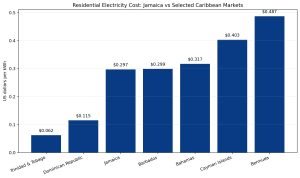
The March 2026 standardized residential figures show a very wide spread.
Residential Electricity Cost Per kWh
Trinidad & Tobago: US$0.062
Dominican Republic: US$0.115
Jamaica: US$0.297
Barbados: US$0.299
Bahamas: US$0.317
Cayman Islands: US$0.403
Bermuda: US$0.487
Standardized residential electricity prices collected in March 2026. The comparison includes power, transmission/distribution and applicable taxes and fees.
Jamaica is therefore nowhere near the most expensive electricity market in the Caribbean.
But it is also nowhere near the cheapest.
The difference between Jamaica and Trinidad & Tobago is particularly striking.
At US$0.062 per kWh, Trinidad and Tobago’s standardized residential price is roughly one-fifth of Jamaica’s US$0.297.
The Dominican Republic is also considerably cheaper at US$0.115 per kWh.
Barbados is almost identical to Jamaica at US$0.299, while the Bahamas is somewhat higher at US$0.317.
The Cayman Islands and Bermuda are substantially more expensive.
So the first conclusion is already clear: Jamaica has expensive electricity by Caribbean standards, but it does not have the most expensive electricity in the region.
Trinidad & Tobago: The Huge Difference
Trinidad and Tobago deserves special attention because the gap is so large.
The country’s official T&TEC residential tariff uses three consumption tiers. The energy charge is TT$0.26 per kWh for the first 400 kWh, TT$0.32 for the next 600 kWh and TT$0.37 above 1,000 kWh. There is also a TT$6 customer charge every two months.
Those rates have been in place since 2009, according to T&TEC’s published tariff information.
Trinidad and Tobago’s electricity generation system is also fundamentally different from Jamaica’s. Its 2024 electricity generation was almost entirely fossil fuel based, but natural gas is the dominant fuel.
That matters because Trinidad and Tobago is a major natural-gas producer, while Jamaica imports the fuels used to generate much of its electricity.
So this is not simply a story about one country having a more efficient electricity company than another.
The underlying energy economics are different.
Dominican Republic: Cheap at the Meter, But With a Catch
The Dominican Republic’s standardized residential electricity price of US$0.115 per kWh is dramatically below Jamaica’s.
But the number needs context.
The Dominican electricity market has a subsidized tariff structure, meaning the price paid by some customers does not necessarily represent the full underlying cost of supplying the electricity.
This is an important distinction.
A household paying a lower electricity bill is certainly paying less. But somebody else may be carrying part of that cost through government support.
That does not make the comparison useless.
It simply means that electricity prices have to be understood alongside the way each country finances and regulates its power system.
Barbados: Almost Identical to Jamaica
Barbados is probably one of the most interesting comparisons because its standardized residential electricity price is almost exactly the same as Jamaica’s.
Barbados was at approximately US$0.299 per kWh in March 2026, compared with Jamaica’s US$0.297.
That is essentially a statistical tie at this level of precision.
But the structure behind the bill is different.
Barbados Light & Power uses a base electricity charge together with a fuel clause adjustment. That fuel component moves with the cost of fuel used in electricity generation.
So even when two countries have almost identical standardized electricity prices, the reason customers arrive at that final price can be very different.
The Bahamas: Higher Than Jamaica
The Bahamas recorded a standardized residential electricity price of approximately US$0.317 per kWh.
That is about 7% higher than Jamaica’s US$0.297 benchmark.
Bahamas Power and Light also separates its base tariff from its fuel charge.
Under the current structure, the first 200 kWh of residential consumption has a zero base-tariff component, while higher consumption is charged at different base rates. Fuel is then passed through separately, with the first 800 kWh receiving a lower fuel-charge rate than consumption above 800 kWh.
The current published BPL fuel charge is 17.4 cents per kWh for consumption up to 800 kWh and 21.4 cents above that threshold.
Again, the lesson is that the headline kWh number does not tell the entire story.
Cayman Islands: Much More Expensive
The Cayman Islands recorded a standardized residential electricity price of approximately US$0.403 per kWh.
That is roughly 36% higher than Jamaica’s standardized benchmark.
Caribbean Utilities Company currently lists a residential energy charge of US$0.1387 per kWh and a monthly facilities charge of US$6.96, with other components including fuel and regulatory charges applied separately.
That is another reminder that a utility’s base energy charge is not necessarily its customer’s final effective price.
Bermuda: Higher Again
Bermuda is even further above Jamaica.
The standardized residential benchmark is approximately US$0.487 per kWh.
That is about 64% higher than Jamaica’s US$0.297 benchmark.
BELCO also uses a fuel adjustment mechanism tied to the cost of purchasing and transporting fuel. The company says changes in fuel costs are passed through to customers.
So Bermuda is a good example of why Jamaica cannot honestly be described as having the highest electricity prices in the Caribbean.
Some Caribbean markets are considerably more expensive.
What About Guyana, Grenada, Saint Lucia and Antigua & Barbuda?
These countries are worth examining, but I would not put them into the same numerical league table without qualification.
Guyana Power and Light’s published residential tariff has a lifeline rate for households using less than 75 kWh and a higher residential energy rate above that level. The published residential energy rate above 75 kWh is GYD43.43 per kWh, alongside a fixed charge.
Grenada’s electricity bill is heavily influenced by fuel. GRENLEC currently lists a domestic non-fuel charge of EC$0.4057 per unit, a fuel charge of EC$0.7388 per kWh and a fuel adjustment clause of EC$0.19490 per unit, with a small renewable-energy charge.
That means the variable components alone can add up quickly.
Antigua and Barbuda uses a similar approach. APUA charges residential customers EC$0.40 per kWh for the first 300 kWh and EC$0.38 above 300 kWh, while a separate fuel variation charge moves with the price of fuel.
Saint Lucia also uses a regulated tariff structure involving fuel-related adjustments.
The problem is that current, independently standardized all-in residential figures for these smaller markets are not consistently published in the same format as the countries in the main comparison.
Rather than inventing precision, I have left them out of the primary ranking.
That is an important part of doing this comparison properly.
Metric Two: What Does 100 kWh Cost?
Per-kWh figures are useful, but most people do not receive a bill saying, “You used 200 units, therefore your bill is exactly this amount.”
There are other charges.
Still, using the standardized residential prices gives us a useful way to understand the scale of the differences.
If every household in our comparison used exactly 100 kWh, the electricity component would look roughly like this:
100 kWh at the Standardized Residential Rate
Trinidad & Tobago: US$6.20
Dominican Republic: US$11.50
United States: US$20.30
Canada: US$11.70
Jamaica: US$29.70
Barbados: US$29.90
Bahamas: US$31.70
Switzerland: US$35.00
Germany: US$41.10
United Kingdom: US$43.80
Cayman Islands: US$40.30
Bermuda: US$48.70
This is a standardized mathematical comparison, not a prediction of an actual household bill. Actual bills vary because of fixed charges, consumption tiers, fuel adjustments, taxes and other components.
That calculation immediately puts Jamaica’s position into perspective.
Jamaica is considerably more expensive than Trinidad and Tobago, the Dominican Republic, Canada and the United States on this measure.
But Germany, the UK, Cayman and Bermuda are more expensive.
Metric Three: Jamaica Compared With the Wider World
Now let’s move outside the Caribbean.
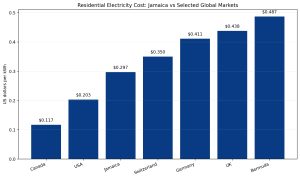
Jamaica vs. Selected Global Markets
Canada: US$0.117/kWh
United States: US$0.203/kWh
Jamaica: US$0.297/kWh
Switzerland: US$0.350/kWh
Germany: US$0.411/kWh
United Kingdom: US$0.438/kWh
Bermuda: US$0.487/kWh
Standardized residential electricity prices, March 2026.
Jamaica’s position is now clearer.
The country is expensive, but it is not an outlier at the very top of the global table.
The March 2026 Jamaica benchmark of US$0.297 was about 75% above the global average of US$0.170.
Canada’s benchmark was just US$0.117, while the United States was US$0.203.
At the other end, Germany was approximately US$0.411 and the United Kingdom US$0.438.
Bermuda was higher still.
Germany Shows Why Price Alone Is Not Enough
Germany is particularly useful because it has a very high electricity price but also much higher average earnings than Jamaica.
Germany’s March 2026 standardized residential electricity price was approximately US$0.411 per kWh.
That is about 38% higher than Jamaica’s benchmark.
So if we stopped the analysis there, someone could reasonably argue that Jamaicans are not paying the world’s highest electricity rates.
That would be correct.
But it would still leave out the question that matters to ordinary households.
How difficult is it to pay the bill?
How Heavy Is Electricity on a Jamaican Worker?
Jamaica’s national minimum wage increased to J$17,000 per 40-hour week from July 1, 2026.
Using 52 weeks divided across 12 months gives a monthly equivalent of approximately J$73,667.
Now take Jamaica’s standardized March 2026 residential electricity price of J$47.001 per kWh.
If a household used exactly 100 kWh in a month, the standardized electricity cost would be approximately J$4,700.
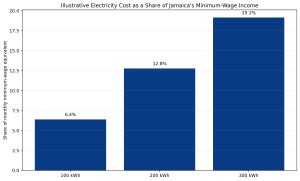
That is about 6.4% of the monthly minimum-wage equivalent.
At 200 kWh, the standardized electricity cost rises to about J$9,400, or approximately 12.8% of that monthly income.
At 300 kWh, it reaches approximately J$14,100, equivalent to roughly 19.1%.
Illustrative Electricity Burden on Minimum-Wage Income
100 kWh: 6.4%
200 kWh: 12.8%
300 kWh: 19.1%
Illustrative calculation using the March 2026 standardized Jamaica residential benchmark of J$47.001/kWh and the 2026 minimum-wage monthly equivalent. It is not an actual JPS bill.
And this is where the conversation becomes much more serious.
For a household using 300 kWh, almost one-fifth of the monthly equivalent of the minimum wage would be represented by the standardized electricity cost alone.
That is before rent, food, transportation, water, telephone service, school expenses and everything else a household has to pay.
It also does not mean every minimum-wage worker personally pays the entire electricity bill.
The calculation is simply a way of showing the scale of the expense relative to income.
What About the United States?
The United States had a standardized residential electricity price of approximately US$0.203 per kWh in March 2026.
That is about 32% below Jamaica’s US$0.297 benchmark.
But the United States is not one electricity market.
Prices vary considerably from state to state, and households face different utility charges and rate structures.
The U.S. Energy Information Administration also reports electricity prices by state because there is no single rate that every American household pays.
So the national figure is useful as a benchmark, not as a claim that every American household receives cheaper electricity than every Jamaican household.
Canada: A Very Different Energy Picture
Canada’s standardized residential price was approximately US$0.117 per kWh.
That is less than half Jamaica’s benchmark.
Canada also has a very different electricity-generation profile.
Hydroelectric power accounted for more than half of Canadian electricity generation in the 2024 data used for the comparison, with nuclear power also providing a substantial share.
Jamaica, by contrast, generated approximately 88.5% of its electricity from fossil fuels in 2024, according to the same underlying energy data.
That difference does not automatically explain every cent on a Jamaican electricity bill, but it helps explain why the energy economics of the two countries are so different.
Switzerland: Expensive Electricity, Different Circumstances
Switzerland’s standardized residential electricity price was approximately US$0.350 per kWh in March 2026.
That is higher than Jamaica.
But Switzerland generated approximately 60.7% of its electricity from hydroelectric sources and another 31.1% from nuclear power in 2024.
So high consumer prices do not necessarily mean a country is heavily dependent on imported fossil fuel.
Taxes, network costs, market structure, investment and other factors can all influence the final residential price.
Germany and the United Kingdom
Germany’s standardized residential price was approximately US$0.411 per kWh, while the United Kingdom’s was approximately US$0.438.
The UK’s current regulated market also demonstrates how complicated electricity pricing can become.
Ofgem’s October to December 2026 price cap sets an average electricity unit rate of 26.32 pence per kWh for customers on default tariffs paying by direct debit, alongside a daily standing charge of 54.83 pence.
The price cap changes every three months and varies by region, payment method and meter type.
So once again, a single national number is useful for comparison but cannot describe every customer’s bill.
Why Is Jamaica’s Electricity So Expensive?
This is the question I think deserves more attention.
Jamaica’s electricity system is still heavily dependent on fossil fuels.
The 2024 generation mix used in the international comparison shows approximately:
- 88.48% fossil fuels
- 5.97% wind
- 3.09% solar
- 2.47% hydro
That means the overwhelming majority of electricity generation remains tied to fuel costs.
JPS says its current fuel mix is approximately two-thirds LNG and one-third oil.
The company also explains that its fuel charge changes with the cost of oil and natural gas purchased for generation.
That means global energy prices can eventually make their way into Jamaican electricity bills.
The movement in JPS’s 2026 fuel rate demonstrates exactly how this works.
The rate was J$33.008 per kWh in March before dropping to J$26.776 in August.
For a household using 300 kWh, a difference of J$6.232 per kWh would represent approximately J$1,870 before considering the rest of the bill.
That is why a household can consume roughly the same amount of electricity from one month to the next and still see a noticeably different bill.
Could More Renewable Energy Change the Picture?
Possibly, but it is not as simple as installing more solar panels and expecting electricity prices to immediately collapse.
Renewable energy projects require investment, financing, transmission infrastructure, grid upgrades and, increasingly, storage and other technologies to manage variable generation.
Still, Jamaica’s current generation mix leaves the country exposed to international fuel prices.
Reducing that exposure could make the electricity system less vulnerable to swings in oil and natural-gas prices over time.
That is one reason the renewable-energy transition matters beyond environmental concerns.
It is also an economic issue.
So, Is Jamaica’s Electricity Among the Most Expensive?
Yes, but we need to be precise about what that means.
Jamaica’s standardized residential electricity price is substantially above the global average.
It is also much higher than Trinidad and Tobago, the Dominican Republic, Canada and the United States.
But Jamaica is not the most expensive electricity market in the Caribbean.
Bermuda and the Cayman Islands are considerably higher on the standardized measure, while Barbados and the Bahamas are around or above Jamaica.
Jamaica also sits below several high-cost European markets.
So the strongest argument is not that Jamaica has the highest electricity prices in the world.
The stronger argument is that Jamaica has relatively expensive electricity while operating with a much lower income base than many countries that also have expensive electricity.
My Take
After going through the numbers, I think the Jamaican electricity debate needs to move beyond the simple question of whether JPS is expensive.
The numbers already answer that.
By international standards, Jamaican electricity is expensive.
But that is only the beginning of the conversation.
What stood out to me most was the gap between Jamaica and some of its Caribbean neighbours.
A standardized residential electricity price of US$0.297 per kWh is almost five times Trinidad and Tobago’s US$0.062 benchmark.
It is also more than two and a half times the Dominican Republic’s US$0.115 figure.
At the same time, Jamaica is cheaper than Bermuda, Cayman and several European markets.
That tells us something important.
The problem cannot simply be explained by saying Jamaica is an island.
Other islands have cheaper electricity.
It also cannot be explained by saying Jamaica has the highest electricity price in the world.
It doesn’t.
The more difficult question is why electricity remains so expensive relative to what Jamaicans earn.
That is where the numbers become uncomfortable.
Using the standardized Jamaica benchmark, 300 kWh represents about 19% of the monthly equivalent of the current minimum wage.
Again, that is not an actual JPS bill. It is a standardized comparison.
But it demonstrates the scale of the problem.
For a household already struggling with food, transportation and housing costs, electricity is not an optional expense.
You cannot simply decide not to have refrigeration. You cannot tell a family not to use a fan in Jamaica’s heat. You cannot operate a business properly without power.
Electricity is part of the basic infrastructure of everyday life.
That is why the real question should not simply be whether Jamaicans are paying more than people in another country.
We should be asking whether the electricity system can become more efficient, less exposed to imported fuel prices and more affordable relative to Jamaican incomes.
Because at the end of the day, the most important number on an electricity bill is not just the price of one kilowatt-hour.
It is how much of a person’s income disappears before the basic necessities of modern life can even be powered.
THE BOTTOM LINE
The price per kilowatt-hour tells you what electricity costs. Consumption tells you how much you use. Income tells you how heavy the bill really is.