

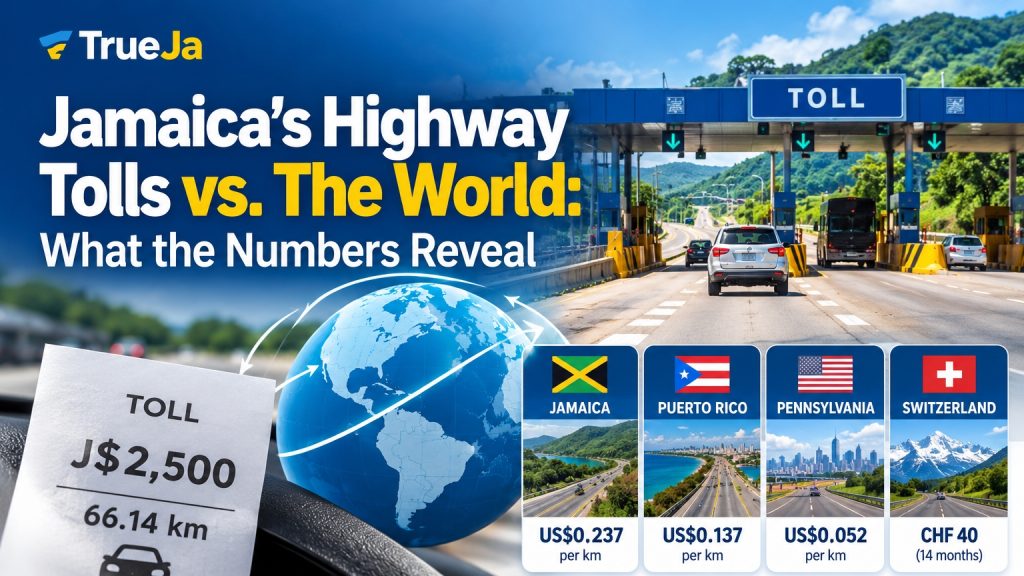
Jamaicans have been complaining about Jamaica’s highway tolls for years, and it is easy to understand why when the numbers are placed beside what motorists in other countries pay.
But simply comparing the price printed on a toll sign does not tell the whole story.
A US$16 toll can actually be cheaper than a US$10 toll if the US$16 payment takes a driver much farther. Likewise, a toll that looks small on paper can become a significant expense when compared with what people earn.
So for this editorial, I looked at Jamaica’s highway tolls from three different angles: the nominal price, the cost per distance travelled, and the toll’s burden relative to income.
The results make for an interesting comparison.
First, What Does Jamaica Actually Charge?
For a Class 1 vehicle, the current North-South Highway 2000 toll schedule lists a charge of J$2,500 for the 66.14-kilometre journey between Caymanas and Ocho Rios at Mammee Bay.
That means a motorist travelling in both directions pays J$5,000 in tolls alone.
Using the Bank of Jamaica’s September 30, 2026 selling rate of J$159.8727 to US$1, the one-way toll works out to approximately US$15.64.
Jamaica: Caymanas to Mammee Bay
66.14 km
J$2,500
J$5,000
~US$15.64
Metric One: The Nominal Price
On the surface, Jamaica’s J$2,500 toll looks expensive. Converted at the exchange rate used for this analysis, it is approximately US$15.64 one way.
But this is where a simple price comparison becomes even more interesting.
Consider Pennsylvania. The Pennsylvania Turnpike’s 2026 mainline rate is 7.3 US cents per mile plus a US$1.13 segment fee. An illustrative 100-mile calculation using one segment fee would therefore cost approximately US$8.43.
That is less than Jamaica’s US$15.64, but the 100-mile example represents about 161 kilometres, compared with Jamaica’s 66.14 kilometres.
It is important to note that the Pennsylvania Turnpike’s actual toll depends on the segments and distance travelled, so the US$8.43 figure is an illustration of the published 2026 rate rather than a claim that every 100-mile trip costs exactly that amount.
That is why the next measurement matters much more.
Metric Two: How Much Are You Paying Per Kilometre?
This is where the comparison changes dramatically.
Jamaica’s US$15.64 toll divided by 66.14 kilometres works out to approximately:
Put another way, a driver is paying approximately US$23.60 for every 100 kilometres travelled on this particular toll-road journey.
Now compare that with other major toll systems.
Toll Cost Per Kilometre
*Pennsylvania is an illustrative 100-mile calculation using the 2026 published per-mile rate and one segment fee. Puerto Rico uses the full 84-kilometre PR-22 route from San Juan to Hatillo and the current Class 1 tolls.
The Pennsylvania comparison provides a useful illustration of how a distance-based toll system can produce a lower effective cost per kilometre. Using the 2026 rate and one segment fee, the 100-mile example works out to approximately US$0.052 per kilometre.
Jamaica’s Caymanas-to-Mammee Bay example is therefore approximately 4.5 times higher per kilometre than that Pennsylvania illustration.
Puerto Rico provides another useful comparison. Its PR-22 runs approximately 84 kilometres from San Juan to Hatillo and has multiple electronic toll points. For a Class 1 vehicle, the current tolls along the full route total approximately US$6.80 one way, or US$13.60 for a round trip.
That works out to approximately US$0.081 per kilometre, placing Jamaica’s US$0.236 per kilometre example at roughly 2.9 times the PR-22 figure.
The Difference Between Price and Value
This is the part of the comparison that I believe deserves more attention.
If one driver pays US$16 to travel 66 kilometres while another pays US$17 to travel 140 kilometres, it would be misleading to simply say the second driver is paying more.
The second driver is buying substantially more distance for roughly the same amount of money.
That is why cost per kilometre gives motorists a different perspective from the price printed on the toll receipt.
And when Jamaica’s current North-South toll is normalized this way, the number becomes much harder to ignore.
Metric Three: What Does the Toll Cost Relative to Income?
The third question is perhaps the most important for Jamaican motorists: how large is the toll compared with what people actually earn?
There is no single wage figure that represents every Jamaican, so two benchmarks are useful here.
The Formal-Sector Earnings Benchmark
Recent reporting based on STATIN data puts average monthly earnings in Jamaica’s formal sector at approximately J$197,000 for 2024-2025. This figure is associated with the large-establishment earnings data and should not be interpreted as the income of every Jamaican worker.
At that level, a J$5,000 round trip to Ocho Rios and back represents:
That is the first income perspective.
Now Consider the National Minimum Wage
Jamaica’s national minimum wage increased from J$16,000 to J$17,000 per 40-hour work week, effective July 1, 2026. The standard hourly rate is J$425.
Converting J$17,000 per week into a monthly equivalent gives approximately J$73,667 per month, using 52 weeks divided across 12 months.
The J$5,000 round trip therefore represents approximately:
That is a very different picture from looking at J$2,500 on a toll sign.
One Round Trip: The Income Perspective
2.54%
6.79%
How Does That Compare With Pennsylvania and Puerto Rico?
The same income calculation provides another useful perspective.
Pennsylvania’s average weekly wage was approximately US$1,550 in the first quarter of 2026. That works out to approximately US$6,717 per month using the same 52-weeks-per-year conversion. A representative round trip based on the 100-mile Pennsylvania Turnpike illustration would cost US$16.86, representing approximately 0.25% of monthly average wages.
Puerto Rico’s average weekly wage was US$724 in the first quarter of 2026, equivalent to approximately US$3,137 per month using the same calculation. The approximately US$13.60 round-trip PR-22 toll example represents about 0.43% of monthly average wages.
Representative Toll Burden Compared With Monthly Earnings
These are representative examples, using round-trip toll figures and the specific wage benchmarks described in the article.
And Then There Is Switzerland
Switzerland is worth mentioning because its motorway system works very differently from Jamaica’s.
Instead of charging motorists every time they pass a toll plaza, Switzerland generally uses an annual motorway vignette. The 2026 vignette costs CHF40 and is valid from December 1, 2025 through January 31, 2027.
At an October 1, 2026 exchange rate of roughly US$1.20 per Swiss franc, CHF40 is approximately US$48.
But that US$48 does not buy one journey.
It provides access to the covered Swiss motorway network for the entire validity period.
That makes Switzerland impossible to compare directly with Jamaica on a simple cost-per-kilometre basis. The two systems charge motorists in fundamentally different ways.
But it does provide an important perspective: a motorist can pay one fixed motorway charge in Switzerland and use the covered network repeatedly throughout the validity period, rather than paying a J$2,500 charge every time they make the Caymanas-to-Mammee Bay journey.
What About the Dominican Republic?
The Dominican Republic also has an extensive toll network, with toll stations including Las Américas, Duarte, 6 de Noviembre, Sánchez, Santiago, Azua, La Romana, Coral and others.
At Las Américas, for example, the official rate for a two-axle light vehicle is currently RD$100.
That works out to roughly US$1.67 at an exchange rate around RD$60 to US$1.
However, a toll-station price by itself cannot fairly be converted into a per-kilometre comparison without establishing the exact route and distance travelled. For that reason, this article does not pretend that a single Dominican toll plaza represents the entire country’s toll system.
So What Do The Three Metrics Tell Us?
1. Nominal price
J$2,500 one way, approximately US$15.64.
2. Cost per distance
Approximately US$0.236 per kilometre or US$0.380 per mile.
3. Income burden
A J$5,000 round trip represents approximately 2.54% of the J$197,000 formal-sector earnings benchmark, or approximately 6.79% of the monthly equivalent of the J$17,000 weekly minimum wage.
The first measurement tells us what the motorist pays.
The second tells us what the motorist pays for the distance travelled.
The third tells us how significant that payment can become when placed against earnings.
And those three measurements tell very different stories from simply saying, “The toll is J$2,500.”
My Take: The Number On The Sign Is Not The Whole Story
There is nothing inherently wrong with comparing toll prices from country to country. But if we stop at the nominal price, we leave out one of the most important questions: how much road are motorists actually getting for that payment?
A US$17 toll for a much longer journey is not necessarily more expensive than a US$16 toll for a much shorter one. The distance has to be part of the calculation.
That is why Jamaica’s approximately US$0.236 per kilometre figure deserves attention.
It is substantially above the representative Pennsylvania and Puerto Rico examples examined here.
Then there is income.
For someone earning around J$197,000 per month, a J$5,000 round trip represents 2.54% of that monthly benchmark. For someone earning the current statutory minimum, the same round trip represents approximately 6.79% of the monthly equivalent of the minimum wage.
Those percentages turn an abstract toll price into something much easier to understand.
And perhaps that is the most important part of this entire comparison.
Jamaica’s highway tolls should not be judged by the price printed on the toll booth alone. They should also be judged by the distance covered and by what that payment represents to the person earning the money.
Once all three numbers are placed side by side, the debate over Jamaica’s highway tolls becomes much bigger than J$2,500.